

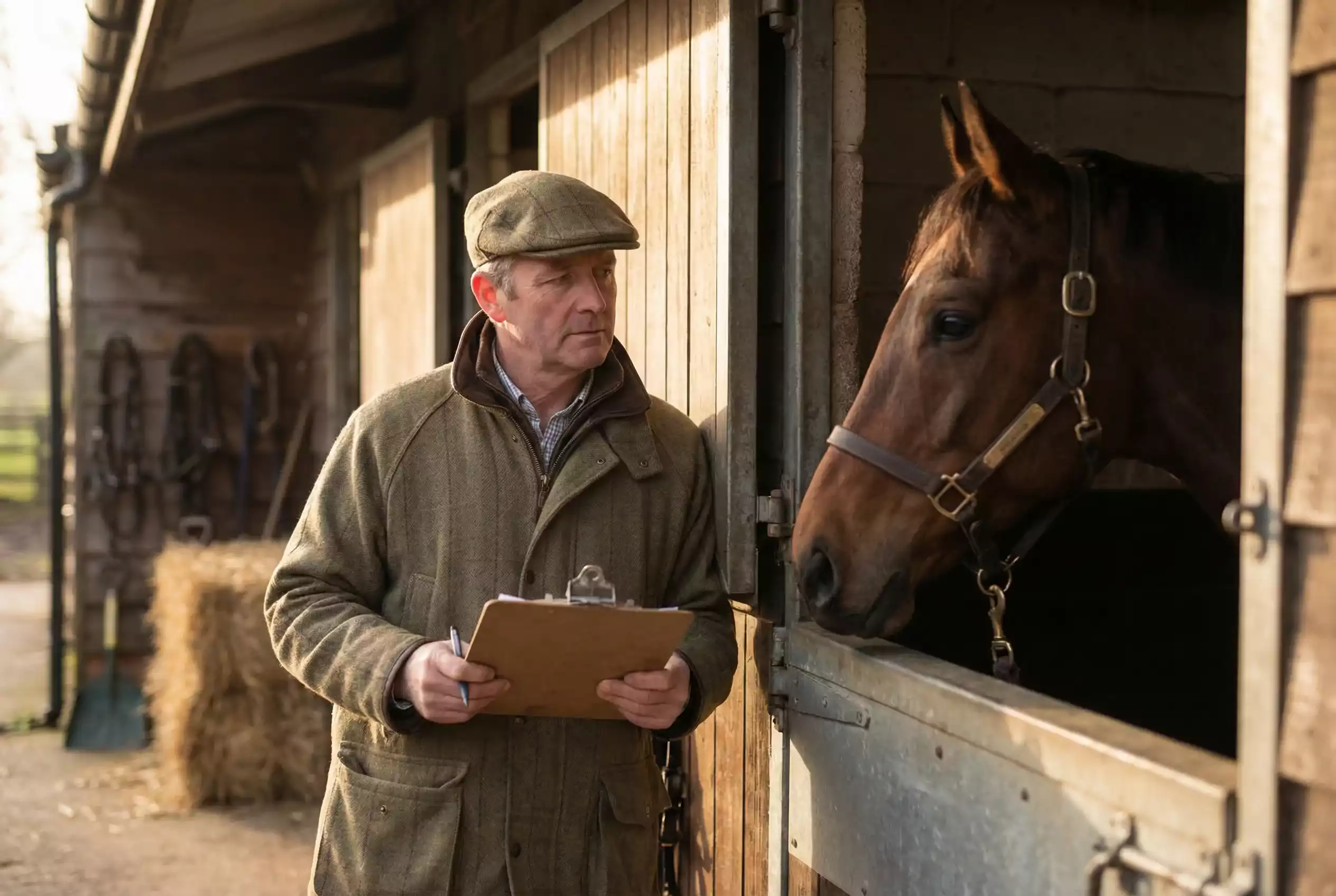
Every punter who has studied a racecard over morning coffee knows the feeling. You have narrowed it down to two horses, weighed the form, checked the going, and placed your bet. Then the phone buzzes: non runner declared. Sometimes it is your selection — stake returned, day recalibrated. More often it is another horse in the field, and suddenly the race you analysed is not the race being run.
Non runners are not random. The British Horseracing Authority identified in 2017 that roughly 90% of all withdrawals fall into three categories: veterinary certificates, self-certificates from trainers, and going changes. That leaves about 10% scattered across less common causes — transport failures, stalls refusals, administrative issues — and it is that smaller slice that tends to generate the most controversy and confusion among bettors.
Understanding why horses get withdrawn is not just academic. Each withdrawal type has a different timeline, a different implication for the rest of the field, and a different signal for your betting. A vet certificate issued on the morning of the race tells you something very different from a self-cert filed two days before. This article breaks each cause apart, explains how the BHA monitors the system, and gives you a framework for responding on the morning of the race when a name disappears from your card.
Veterinary Certificates — When the Vet Says No
The veterinary certificate is the most straightforward reason a horse gets scratched, and the hardest to argue with. A qualified vet examines the animal — sometimes at the trainer’s yard, sometimes at the racecourse itself — and determines it is unfit to run. The certificate is filed with the BHA, the horse is removed from the field, and the matter is closed. No debate, no appeal, no discretion from the trainer. The vet’s word is final.
Injuries are the most common trigger. A horse might show signs of lameness during morning exercise, present heat in a leg that was not there the day before, or fail a trot-up at the course. Respiratory infections are another frequent cause, particularly during the winter jump season when yards are more susceptible to outbreaks. When a virus moves through a large stable, multiple runners from the same trainer can be withdrawn on the same day — which is exactly what happened at Cheltenham Festival 2024, when Nicky Henderson was forced to scratch seven horses from his squad due to illness.
There is a regulatory consequence attached. Under BHA rules, a horse withdrawn on a vet certificate cannot run for a minimum of two days after the scheduled race. This cooling-off period exists to prevent trainers from gaming the system — withdrawing a horse on supposed veterinary grounds, then running it the next afternoon at a different course. The two-day standdown makes the vet cert a meaningful commitment: you are not just missing today’s race, you are missing the next available opportunity as well.
For punters, a vet certificate withdrawal carries a specific signal. It usually appears on the morning of the race or even at the course, meaning it is a late change. Late withdrawals trigger Rule 4 deductions for anyone who bet on the remaining runners at pre-withdrawal odds. But a vet cert also suggests the withdrawal was genuinely unavoidable — unlike self-certification, which sometimes invites scepticism. If a well-fancied horse is scratched on veterinary grounds, the market will adjust quickly, and the remaining field may represent better or worse value depending on how much the withdrawn horse was shaping the race.
The vet certificate process is also one of the few withdrawal mechanisms that operates independently of the trainer’s commercial interests. A trainer might prefer to run a horse that is slightly below par — the owner has travelled, the race conditions suit, the entry fees are paid — but if the vet says no, the trainer’s preference is irrelevant. That independence is built into the system by design, and it is why vet cert withdrawals attract less scrutiny from the regulator than other categories.
Self-Certification — The Trainer’s Own Call
Self-certification is where the system gets interesting — and where the tension between welfare, competition and commercial pressure becomes most visible. Unlike a vet cert, where an independent professional makes the call, self-certification allows the trainer to withdraw a horse on their own authority. The trainer declares, effectively, that the horse should not run, without needing a vet to confirm it.
The reasons behind a self-cert are varied and not always transparent. A trainer might feel the horse has not worked well enough in the days leading up to the race. The ground might be changing in a direction that does not suit the horse’s profile. The horse might have eaten poorly, shown behavioural signs of discomfort, or simply failed to meet the trainer’s subjective threshold for readiness. None of these need to be documented to the same standard as a veterinary assessment. The trainer files the certificate, the horse comes out, and the explanation — if one is offered publicly — is typically brief.
This latitude is both practical and problematic. Practical because trainers know their horses better than anyone. A subtle change in temperament or a slight loss of appetite might not be detectable by a vet during a short examination, but a trainer who sees the animal every day recognises it immediately. The self-cert system trusts that expertise. The problem is that it also creates room for withdrawals that are driven by convenience rather than genuine concern — a horse entered speculatively to keep options open, then scratched when a better opportunity appears elsewhere, or when the trainer simply changes their mind about the race plan.
The BHA has been well aware of this tension for years. The 2017 reform package specifically targeted self-certification abuse by introducing monitoring thresholds. If a trainer’s self-cert rate rises above a certain level — relative to the average — they lose the ability to self-certify for twelve months. During that ban period, every withdrawal must come through an independent vet, which is more time-consuming, more expensive, and far less convenient. The threat of losing self-cert privileges acts as a deterrent, nudging trainers to use the mechanism honestly rather than habitually.
From a punter’s perspective, self-cert withdrawals are harder to interpret than vet certs. A vet cert almost always means a genuine health issue. A self-cert might mean the same, or it might mean the trainer did not fancy the race conditions, or it might mean the owner wanted to redirect the horse to a different meeting. The ambiguity means you cannot read a self-cert non runner the same way you read a vet cert. What you can do is check whether the trainer has form for late self-cert withdrawals — the BHA publishes this data — and factor that pattern into your assessment of which horses in the field are likely to stand their ground.
Going Changes — How Ground Conditions Force Withdrawals
If vet certificates are the clinical reason horses get withdrawn and self-certs are the subjective one, going changes sit somewhere in between — an objectively measurable shift in conditions that forces a subjective decision from the trainer. The ground changes, and trainers must decide whether their horse still has a realistic chance. Many conclude it does not.
The scale of the effect is significant. According to the BHA Racing Report from November 2024, 78% of Jump fixtures in the first three months of 2024 took place on soft or heavy ground, compared to a three-year average of 48%. That is not a marginal shift — it represents a fundamental change in the surface that every horse in every race had to contend with. When nearly four out of five meetings run on testing ground, the pool of horses genuinely suited to those conditions shrinks, and the non-runner count rises accordingly.
Going changes operate on two timescales. The first is the known forecast: rain is predicted for the next three days, the clerk of the course issues an updated going description, and trainers who entered their horses for good-to-firm ground see the writing on the wall. These withdrawals typically happen within the 48-hour or 24-hour declaration window, before the racecard is finalised. They are disruptive to field sizes but at least give the market time to adjust.
The second timescale is the overnight shift. Heavy rain falls after declarations have closed. The going moves from good to soft, or from soft to heavy, between the evening and the morning of the race. Trainers arrive at the course, walk the ground, and pull their horse. These are the withdrawals that hit punters hardest, because bets have already been placed and the field you analysed at 9pm is not the field you see at 9am. Rule 4 deductions follow, and the entire race dynamic may be different.
Certain types of horse are disproportionately affected. Flat horses bred for fast ground — typically those with American or Australian pedigree influence — are far more likely to be withdrawn when the going turns soft. Jump horses bred for stamina tend to handle softer ground better, but even in National Hunt racing, there is a threshold. The difference between soft and heavy is not trivial: heavy ground saps energy, increases the risk of injury, and turns a stamina test into a survival exercise. Trainers with valuable horses — particularly those aimed at festival targets later in the season — often err on the side of caution, choosing to miss a midweek card rather than risk a setback on gruelling ground.
For the bettor, going-related withdrawals are the most predictable category of non runner. You cannot predict a virus or a transport breakdown, but you can check the forecast. If rain is expected and the ground is already yielding, the probability of withdrawals rises measurably. Building that check into your morning routine — before you look at prices — puts you one step ahead of the market, because by the time the non runners are officially announced, the odds have already moved.
Transport and Logistics — Horses That Never Reach the Racecourse
This is the category that generates the most frustration because it feels entirely avoidable. A horse is fit, the ground suits, the trainer wants to run — but the horsebox breaks down on the M4, or a motorway closure adds two hours to the journey, or the vehicle is delayed at the racecourse entrance. By the time the horse arrives, the race has gone off or the animal is too unsettled to run safely. Non runner declared, bets voided, and nobody is satisfied.
Transport-related withdrawals account for a small percentage of the total, but they cluster around specific conditions. Winter weather — ice, snow, fog — is the most obvious trigger. British B-roads leading to rural courses can become impassable overnight, and horseboxes are not built for black ice. Even on motorways, a jackknifed lorry or a serious accident can block the route for hours, and unlike a car, a horsebox cannot easily divert through narrow lanes.
There is also a welfare dimension. Horses that have spent an unexpectedly long time in transit may arrive stressed, dehydrated or physically stiff. A trainer who has driven for five hours instead of the planned two must decide whether the horse is in any condition to race. The BHA expects trainers to prioritise the animal’s welfare in these situations, and most do — which means a horse that technically arrived in time might still be scratched on the trainer’s assessment that it is not fit to compete after a difficult journey.
Racecourse infrastructure plays a role too. Larger courses with dedicated stabling and multiple entry points handle arrivals more smoothly than smaller venues. At some tracks, a bottleneck at the horsebox park can delay unloading by enough to make a tight schedule unworkable. Trainers with multiple runners at the same meeting sometimes face logistics conflicts — one horsebox, two races an hour apart, and the second runner does not make it in time.
For punters, transport-related non runners are essentially unpredictable. You cannot model them into your handicapping. What you can do is note the conditions: if there is severe weather or major infrastructure disruption on race morning, expect a higher-than-usual number of late withdrawals, particularly at courses that are geographically isolated or difficult to access.
Stalls Refusal and Bolting — The Grey Area Before the Start
This is the withdrawal category that has undergone the most significant regulatory change in recent years, and it sits in genuinely awkward territory. The horse has made it to the racecourse, passed the vet check, been saddled, paraded, and loaded — or attempted to be loaded — into the starting stalls. Then it refuses. Or it enters the stalls but panics, rears, and is deemed unsafe. Or it bolts before the tape drops in a jump race. What happens next used to be a mess. Now there are rules, though they are still being tested.
Prior to May 2024, a horse that refused to enter the stalls or caused a disruption at the start was not automatically declared a non runner in any meaningful sense for betting purposes. Stewards had limited powers to intervene, and the consequences for bettors were inconsistent. The horse might be withdrawn, but the process lacked the clear framework that applied to pre-race non runners.
That changed on 1 May 2024, when the BHA introduced a rule giving stewards the explicit authority to declare a horse a non runner at the start if it had been denied a fair start from the stalls. The rule applied initially to Flat races only. Then, from 1 October 2025, it was extended to Jump races and all non-stalls starts — barrier starts, tape starts, flag starts — aligning British racing with the model recommended by the International Federation of Horseracing Authorities.
The practical effect is that a horse which bolts, refuses to load, or is otherwise prevented from starting fairly can now be officially scratched by the stewards on the spot. For bettors, this means the standard non-runner refund and Rule 4 framework kicks in, rather than the previous grey area where the horse might technically have been “under orders” but never actually competed. The change is designed to protect both the betting public and the horse — an animal that has already been distressed at the start should not be forced to race, and a punter whose horse never left the stalls should not be treated as having lost a bet.
Stalls refusals are more common than many casual racegoers realise, particularly among younger Flat horses with limited racecourse experience. The stalls environment is noisy, confined and unfamiliar. Some horses handle it well from their first start; others take several attempts before they load reliably. Trainers are generally aware of which horses are stalls-shy, and most will withdraw them before race day if they are concerned. But occasionally a horse that loaded cleanly in the morning trial refuses in the afternoon, and the situation plays out in real time in front of the cameras.
How BHA Monitors Non Runner Patterns Among Trainers
The BHA does not simply record non runners and move on. It tracks them, publishes them, and acts on them. The monitoring system is one of the most concrete tools the regulator has to ensure that withdrawals are driven by genuine need rather than tactical convenience, and it carries real consequences for trainers who exceed the thresholds.
The system works on a quarterly cycle. The BHA compiles non-runner rates for every licensed trainer in Britain, broken down by self-certification and veterinary certificate. These figures are published on the BHA’s website, making them available to anyone — including punters, owners and the racing press. Transparency is part of the deterrent: a trainer whose self-cert rate is conspicuously high cannot hide behind a quiet filing.
The trigger thresholds are specific. On the Flat, a trainer whose self-certification rate exceeds 12% — which represents 50% above the average, as established in the 2017 BHA measures — faces a ban on self-certifying for twelve months. For Jump racing, the threshold is 9%. Once the ban is imposed, every subsequent withdrawal from that trainer must be supported by an independent veterinary certificate. The ban does not prevent the trainer from withdrawing horses; it removes the convenience of doing so without a vet’s involvement.
“It is essential we take these steps to reduce the number of non-runners. They are not good for our sport, its fans or its participants,” Richard Wayman, BHA Chief Operating Officer, stated in 2018, when the first batch of thirteen trainers received self-certification bans under the new system.
The data itself reveals patterns. The average non-runner rate for Jump trainers in 2024 was 6.01%, with the highest individual rate reaching 13.39%. That spread — from 0% to over 13% — tells you that trainer behaviour varies enormously. Some yards run almost everything they declare, absorbing suboptimal ground and minor setbacks as part of the game. Others are more selective, using declarations as options rather than commitments, and withdrawing whenever conditions are less than ideal.
For punters, the BHA’s published data is an underused resource. If you are considering a bet on a horse trained by someone with a consistently high self-cert rate, you should factor in the elevated probability that the horse might not run — especially in conditions that could prompt a withdrawal. Conversely, trainers with very low non-runner rates tend to run their horses unless something is genuinely wrong, making their declarations a stronger signal of intent.
The monitoring system is not perfect. It relies on aggregate rates, which means a trainer could have a low annual average but a spike in withdrawals at specific meetings or on specific ground types. The quarterly snapshots also lag real-time behaviour by several weeks. But as a structural deterrent, it has worked: the BHA reported a 14% drop in non-runner rates in the first quarter after the 2017 measures were introduced, falling from 6.6% to 5.7%.
Seasonal Withdrawal Trends — Flat vs Jump, Winter vs Summer
Non runners do not distribute evenly across the calendar. The reasons for withdrawal are seasonal, and the patterns are consistent enough to be useful for anyone who bets regularly throughout the year.
Jump racing carries a structurally higher non-runner rate than the Flat, and the gap widens in winter. The combination of testing ground conditions, longer journeys to remote National Hunt courses, and the physical demands placed on jump horses means that withdrawals peak between November and March. When the ground is at its worst — heavy, waterlogged, bordering on unraceable — trainers protecting valuable horses will pull them rather than risk injury on ground that offers no footing. The opening months of 2024, as noted above, saw historically extreme conditions that pushed non-runner counts well above the norm.
The Flat season runs from roughly April to October, with the turf season concentrated in summer. Non-runner rates on the Flat are generally lower because the ground is typically faster and more consistent, journeys to courses are shorter on average, and the population of Flat horses is larger. But there are exceptions. A prolonged dry spell in July or August can produce ground officially described as firm or even hard, and trainers of horses that need some give underfoot will scratch them rather than risk jarring injuries. Royal Ascot week in June, for instance, occasionally produces a cluster of going-related withdrawals if the track dries out faster than expected.
The broader trend in horse population also matters. The number of horses that ran at least once in Britain fell by 178 in 2024, a decline of about 1%, with Flat numbers rising marginally and Jump numbers dropping by 3%. Among top-rated Jump horses — those rated 130 or higher — the decline was 9%, from 787 to 716. Fewer quality horses in training means smaller fields, which in turn means each non runner has a larger proportional impact on the race. A single withdrawal from a six-runner novice hurdle reshapes the contest far more than one from a twenty-runner handicap at Ascot.
Seasonal awareness does not require sophisticated modelling. A simple rule of thumb: during the core winter Jump months, expect more non runners per card and build that expectation into your staking. During the summer Flat season, non runners are less frequent but can cluster around weather extremes — heatwaves and sudden storms alike. The spring and autumn transitional periods, when the codes overlap and going conditions are in flux, produce the widest variance in non-runner rates from one week to the next.
What a Punter Should Do When a Withdrawal Hits Your Card
The notification comes through and your first instinct is to check whether it is your horse. If it is, the process is simple: your stake is returned, your bet is void, and you move on to the next race. But if the non runner is another horse in the field — which is far more common — you have a decision tree to work through, and working through it quickly is what separates a reactive punter from a prepared one.
Start with the basics. How short was the withdrawn horse? If it was the favourite or joint-favourite, the market is going to move significantly, and a Rule 4 deduction will apply if you have already bet. Check the deduction band — the table in your bookmaker’s rules section will tell you exactly how much will be taken from your winnings. If the withdrawn horse was a long shot, the impact is smaller and the deduction may be zero or waived entirely.
Next, consider the race shape. Did the withdrawn horse lead the market for a reason? Was it the likely pace-setter, the only front-runner, the horse drawn in stall one on a course where the rail matters? Every withdrawal changes the race, but not every withdrawal changes it equally. A pace horse coming out of a five-runner Group race is a bigger deal than a 25/1 shot leaving a twenty-runner handicap. Your original analysis may still hold, or it may need recalibrating entirely.
If you have not yet bet, the withdrawal is an opportunity rather than a problem. Wait for the market to settle. The initial reaction to a non runner is often an overcorrection — the second favourite shortens too aggressively, outsiders drift when they should not. If you have a strong view that the market has overreacted, that is when value appears. The window is narrow, typically fifteen to thirty minutes after the announcement, but it exists.
If you have already bet at fixed odds, your options are limited. You cannot cancel the bet (unless it is on an exchange before matching), and you cannot avoid the Rule 4 deduction. What you can do is hedge. On the exchange, you might lay your own horse at the new, shorter price to lock in a profit regardless of the deduction. Or you might accept the deduction and let the bet stand if your analysis of the remaining field still supports the selection.
The key principle is: do not ignore a non runner. It is new information. Treat it the way you would treat any other material change — a jockey switch, a significant market move, or a going change. On the morning of the race, the card you see is the card you bet. If that card has changed, your assessment should change with it.
Why Horses Get Withdrawn — More on this topic at non runners horses today.
See also Non Runner No Bet Offers.
