

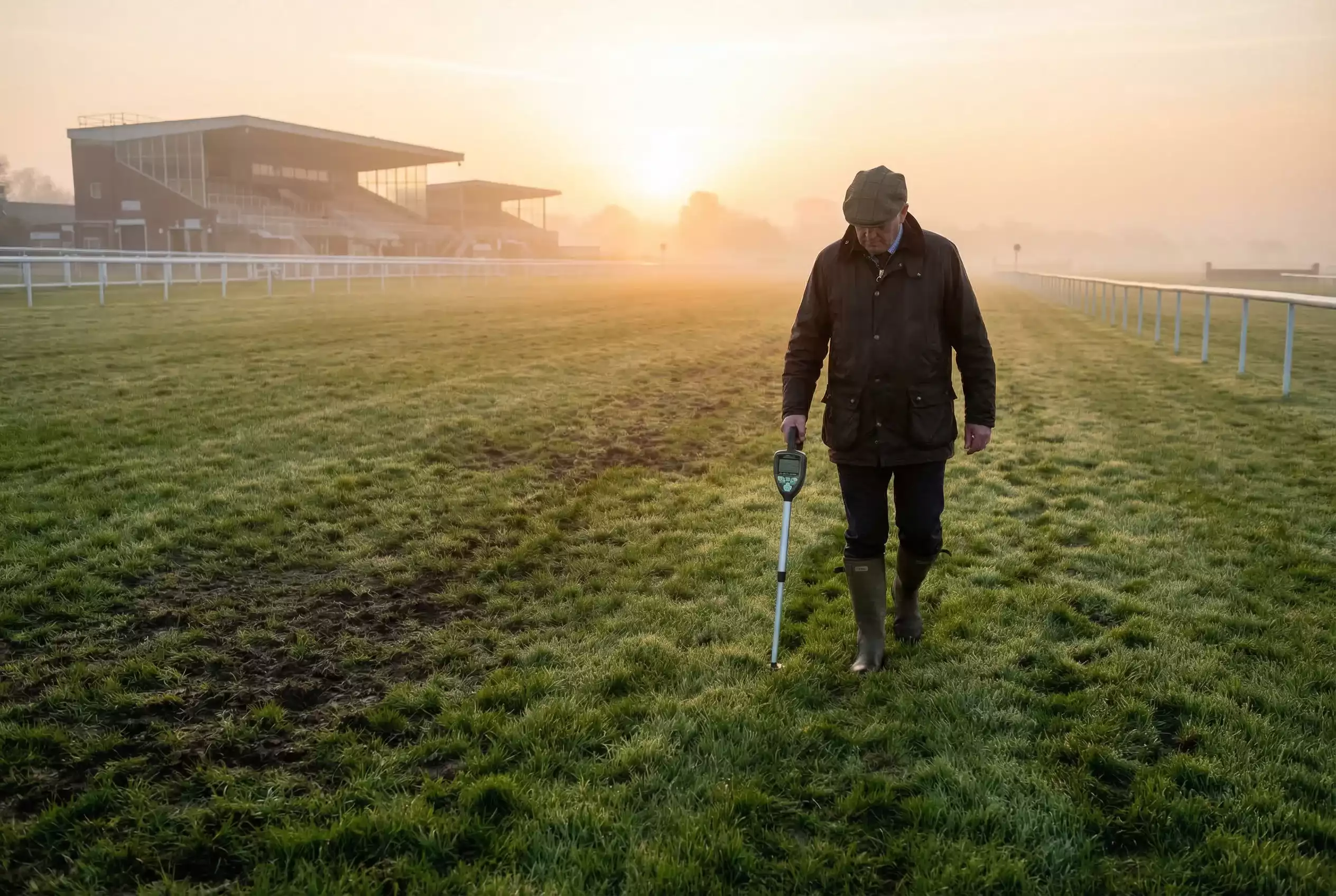
Every withdrawal has a trigger, but one trigger outweighs all others in frequency and scale: the ground underfoot. Going conditions are the single biggest environmental driver of non runners in British racing, and the data is unambiguous. According to the BHA Racing Report from November 2024, 78% of Jump fixtures in the first three months of 2024 took place on soft or heavy going, compared to a three-year average of just 48%. That is not a marginal fluctuation — it is a systemic shift that pushed non-runner rates upward across the entire National Hunt calendar.
For punters, going is the variable hiding in plain sight. It determines which horses run, which are withdrawn, how the field reshapes, and where value shifts after the racecard changes. A going report is not background information to glance at and forget — it is an active signal, updated throughout race day, that tells you more about likely non runners than any other single data point. Understanding how going is measured, what the descriptions actually mean, and how to interpret changes between declaration and the off is the foundation of informed race-day betting. Everything else — form, draw, pace — sits on top of whatever is underfoot.
The Official Going Scale — From Hard to Heavy and Everything Between
The going scale used in British racing runs from Hard at one extreme to Heavy at the other, with multiple gradations between. The full sequence for turf is: Hard, Firm, Good to Firm, Good, Good to Soft, Soft, Soft to Heavy, and Heavy. All-weather surfaces use a separate scale — Standard, Standard to Slow, and Slow — because synthetic tracks behave differently from natural turf, draining and compacting in ways that do not map onto the turf terminology.
Each description refers to the resistance the ground offers to a horse’s hoof at the point of impact and push-off. Hard ground provides almost no give; the hoof lands on a surface that does not yield, which transfers more concussive force through the leg. Firm ground has slightly more cushion but remains fast. Good to Firm is what most Flat trainers consider ideal for speed-oriented horses — enough pace in the surface to reward quick action, with just enough cushion to reduce jarring. Good ground is the neutral point on the scale, acceptable to the widest range of horses across both codes.
Once you cross into Good to Soft, the dynamics shift. The surface begins to hold moisture, the hoof sinks deeper, and each stride demands more energy. Soft ground tests stamina over speed. On Heavy going, the ground is saturated — hooves sink several inches, the running surface becomes uneven, and the race becomes an endurance contest that bears little resemblance to the same race on Good ground. Horses bred for speed and quick action often cannot handle it; horses bred for stamina and power thrive on it. The going description is, in effect, a filter that determines which section of the horse population is competitive.
The scale also features in-between descriptions — Good to Firm in places, Soft in places — which indicate that the going varies across different parts of the course. This happens when rain has affected lower-lying sections but not ridges, when ground near the rail has been chewed up by previous races but the outer track is intact, or when watering has been applied unevenly. These localised descriptions are common at larger courses with undulating terrain and can influence draw bias, running style and, critically, whether a trainer decides to withdraw.
For punters assessing non-runner risk, the key thresholds are the transitions from Good to Good to Soft and from Soft to Heavy. These are the points where trainer decision-making shifts most visibly. A horse entered for a race on Good ground may tolerate Good to Soft without drama. But if the going moves to Soft overnight, the calculation changes — and if it reaches Heavy, the withdrawal becomes probable for any horse that needs decent ground underfoot.
How Going Is Measured — GoingStick, Penetrometer and the Clerk’s Walk
The going description is not a guess. It is determined by the clerk of the course using a combination of objective measurement tools and subjective assessment, and the process is more rigorous than most casual racegoers assume.
The primary instrument is the GoingStick, a mechanical device that is pushed into the turf and measures both the penetration depth and the shear resistance of the surface. The stick produces a numerical reading — typically on a scale where higher numbers indicate firmer ground. A reading of 10 or above corresponds roughly to Good to Firm, while readings below 5 indicate Soft to Heavy territory. The GoingStick provides a standardised, reproducible measurement that can be compared across locations and days, reducing the subjectivity that historically plagued going descriptions.
Older courses and certain scenarios also involve the penetrometer, a simpler device that measures how far a weighted rod sinks into the ground when dropped from a fixed height. The penetrometer is less sophisticated than the GoingStick but provides a quick cross-reference, particularly useful when the clerk needs a rapid check after sudden rainfall.
Neither tool replaces the clerk’s walk. Before racing and at several points during the day, the clerk walks the course — sometimes the entire circuit, sometimes key sections — physically assessing the ground condition by foot. The walk captures things instruments miss: localised drainage issues, the feel of the surface under a boot, areas where previous racing has cut up the turf, and the general behaviour of water on the surface after rain. The clerk integrates the GoingStick data, the penetrometer readings and their own experience into a single going description, which is then published to the media, bookmakers and the BHA.
The crucial point for punters is that the going description is an aggregate. It represents the clerk’s best assessment of the overall track condition, but the ground is not uniform. Faster-draining sandy soil near the stands may be Good while a clay-bottomed section at the far turn is Soft. The published going is a central estimate, not a guarantee of consistency. Trainers who know a specific course well — who know where it drains, where it holds, where the ground rides different from the official description — have an informational advantage over casual bettors relying solely on the headline figure.
The Numbers — How Soft and Heavy Going Push Up Non Runner Rates
The relationship between going conditions and non-runner rates is not linear — it is exponential at the extremes. On Good ground, non-runner rates are at their baseline: trainers run what they have declared, withdrawals are driven by injury or administrative issues rather than conditions. Move to Good to Soft and the rate begins to climb as trainers with speed-dependent horses start to think twice. By the time the going reaches Soft or Heavy, withdrawals spike.
The 2024 data put this into sharp relief. With 78% of Jump fixtures in Q1 running on soft or heavy ground — nearly double the 48% three-year average — the conditions created a sustained period of elevated non-runner activity. Field sizes reflected the pressure: on Jump Premier racedays, average field sizes fell from 9.69 in 2023 to 9.22 in 2024, according to BHA’s full-year report. That drop does not sound dramatic in isolation, but across hundreds of races it represents thousands of fewer runners — and each missing runner was a non-runner that contracted the competitive picture.
The Flat tells a different story in the same period. Flat Premier field sizes actually rose, from 10.50 to 10.86, reflecting the generally faster ground conditions that the Flat season enjoys and the lower non-runner pressure that comes with them. The contrast is instructive: same sport, same year, but the relationship between going and withdrawals produced opposite trends across the two codes.
“We wanted to make our best racing better and use that as our tool to grow interest in the sport,” Richard Wayman, BHA Director of Operations, noted in 2025, commenting on the fixture restructuring designed partly to address the going problem. The BHA’s approach — moving races away from periods when extreme ground is most likely — is an institutional acknowledgement that going conditions do not just affect individual races; they shape the entire competitive landscape.
For punters, the correlation creates a simple decision framework. When the going is Good or faster, non-runner risk is low and the card you see at declaration time is likely the card you will bet. When the going is Soft or worse, non-runner risk rises materially, and the card is provisional — a starting point that may lose runners by the morning of the race. Treating the going description as a probability input, not just a form factor, changes how you plan your betting day.
Seasonal Going Patterns and Their Effect on Declarations
British weather follows patterns, and so does the going. The seasonal cycle is predictable enough to build into your betting planning, even if the specifics of any given week are always uncertain.
Spring — March through May — is the most variable period. The ground is drying out from winter, but rainfall remains frequent and often heavy. Going can shift from Soft to Good to Soft within a single week, and courses in the north and west dry out more slowly than those in the south-east. The Cheltenham Festival falls in this window, which is precisely why non-runner rates at the meeting are elevated. By late April, most Flat courses are racing on Good or better, but the Jump courses finishing their season may still be dealing with lingering moisture.
Summer brings the firmest ground. From June through August, particularly during prolonged dry spells, the going at Flat courses can harden to Firm or even Good to Firm in places bordering Hard. Non-runner rates drop to their annual low, but the small number of withdrawals that do occur tend to be going-related in the opposite direction — trainers pulling horses that need softer ground. Royal Ascot, Glorious Goodwood and the July Festival at Newmarket all benefit from summer conditions, producing large fields and minimal non-runner disruption in most years.
Autumn — September through November — is the transition. Rain returns, turf courses soften, and the Jump season begins. The total number of horses that competed in British racing fell by 178 in 2024, a 1% decline to 18,452, with Jump runners accounting for the larger share of the drop. As the ground turns, trainers of horses re-entering training after a summer break face a choice: run on ground that may be softer than ideal, or wait for conditions to improve. Many wait, and the non-runner count starts climbing.
Winter — December through February — is peak non-runner season for Jump racing. Short days, persistent rain, frost and occasional snow produce ground conditions that range from Soft to unraceable. Meetings are abandoned, races are rescheduled, and the cards that do survive often have smaller fields than those declared. For punters, winter Jump racing requires a higher tolerance for disruption and a clear-eyed view that the field you plan around may not be the field that runs.
Going Trends at Major UK Racecourses
Not all courses are created equal when it comes to ground conditions, and the differences are structural — determined by geography, soil type, drainage investment and microclimate. Knowing which courses tend toward which end of the going scale helps you anticipate non-runner risk before the official going is even published.
Cheltenham sits in a Gloucestershire valley that collects rainfall and retains moisture. The Old Course and New Course drain at different rates, and the hill section is notoriously testing when the ground is soft. Winter meetings at Cheltenham frequently race on Soft or Heavy, and the Festival in March regularly features ground on the softer side of Good. Non-runner rates at Cheltenham reflect this: trainers know the course, know the ground, and withdraw horses that cannot handle it.
Ascot, by contrast, benefits from significant drainage investment and a sandy subsoil that sheds water relatively quickly. The course can race on Good ground within days of heavy rain, which is unusual for a course of its size. Royal Ascot in June almost always features ground on the faster side, which keeps non-runner rates low during the biggest Flat meeting of the year. Winter Jump meetings at Ascot are a different matter — the course can produce testing ground in December and January, though less extreme than courses further west.
Newmarket’s two courses — the Rowley Mile and the July Course — sit on chalk downland that drains exceptionally well. The going is predominantly Good to Firm or faster during the Flat season, and non-runner rates are among the lowest of any major venue. The course’s location in East Anglia, one of the driest regions in Britain, gives it a structural advantage that is reflected in consistently large field sizes.
At the other end of the spectrum, courses such as Haydock, Wetherby and Catterick in the north of England experience higher rainfall and heavier soils. Winter meetings at these venues are frequently on Soft or Heavy ground, and non-runner rates track accordingly. The BHA’s fixture restructuring acknowledged this geography: in 2024, approximately 300 fewer Jump races were programmed, and 200 Flat races were shifted from summer to autumn to improve field competitiveness at courses where ground conditions are most challenging.
The lesson for punters: treat the going forecast differently depending on the course. A going description of Good to Soft at Newmarket might still produce full fields, because the course drains well and trainers trust the surface underfoot. The same description at Haydock in November might prompt three or four withdrawals, because experience tells trainers that Good to Soft at Haydock often rides closer to Soft. Course-specific knowledge is one of the quieter edges available to anyone willing to learn the geography.
Reading the Going Report to Spot Non Runner Risk
The going report is published information. It is available to every punter, every trainer, every bookmaker. The edge does not come from having access — it comes from reading it properly and acting before the market catches up.
Start with the direction of change, not the current description. A course described as Good to Soft is a neutral fact. A course that was Good yesterday and is Good to Soft today is a trend — and if rain is forecast for the next twelve hours, that trend is likely to continue toward Soft. Trainers respond to trajectories, not snapshots. A trainer whose horse needs Good ground will tolerate Good to Soft if the forecast is drying, but will pull the horse if the forecast is wet. The going report tells you where the ground is; the weather forecast tells you where it is heading. Read both.
Second, check for the phrase “in places.” When the clerk of the course reports Good to Soft, Soft in places, the ground is not uniform. Specific sections — often the far turn, the dip, or areas near the inside rail — are significantly softer than the headline description suggests. Horses drawn to race on the inside, or those whose running style takes them to the softer parts of the track, face different conditions from those racing on the outside. Trainers who know the course layout will factor this in, and some will withdraw rather than expose their horse to ground that is worse than the published description implies.
Third, pay attention to the timing of going updates. The clerk issues an initial report on the day before racing, an update on the morning of racing, and sometimes a further update between races if conditions change. Each update is a data point. If the going is revised from Good to Soft to Soft between the morning and the second race, non runners are likely to appear in later races on the card. Trainers who were borderline at the morning stage may decide the afternoon conditions have crossed their threshold.
Finally, use going reports as a filter rather than a factor. Before assessing form, draw, pace or price, ask one question: given the current going and the forecast, which horses in this field are at risk of withdrawal? Mentally remove them from the card. If the race still looks competitive and your selection still makes sense in a reduced field, the bet has survived the first screen. If the race depends on a horse that may not run, you are building your analysis on shifting ground — literally underfoot.
Same-Day Going Changes — When the Ground Shifts After Declarations
This is where going conditions cause the most disruption to betting markets. Declarations close, the racecard is published, prices form, bets are placed — and then the ground moves. Overnight rain, an unexpected downpour during the morning, or even heavy watering by the clerk to maintain safe racing surface can shift the going between declaration and the off. The card you planned around is no longer accurate.
Same-day going changes produce the sharpest non-runner spikes because the window for reaction is short. A trainer may have declared at the 48-hour or 24-hour stage when the ground was Good to Soft, fully intending to run. Forty-eight hours later, the course is Soft. The trainer walks the course, checks the GoingStick readings, and decides the risk is not worth it. The horse comes out, the racecard shrinks, and Rule 4 deductions cascade across the remaining runners’ backers.
The most acute scenario is persistent rain from the evening before racing through to the morning. Trainers who declared based on a forecast that proved wrong face a genuine dilemma: run on ground that does not suit the horse, or withdraw and accept the administrative and reputational consequences. Most trainers prioritise the horse’s welfare and long-term soundness over a single race engagement, and rightly so. But the punter who bet on the original field does not get that luxury — their money is already committed.
For bettors, same-day going changes create a specific tactical window. The non-runner announcements that follow a going change tend to cluster in the hour or two after the clerk publishes the updated report. If you see the going revised downward — say, from Good to Soft to Soft — early in the morning, delay your betting on the afternoon card. Wait for the non-runner declarations to land, assess the revised field, and then bet on the race as it will actually be run. The early-morning price may have been better, but the afternoon price is based on reality rather than a forecast that did not hold.
Courses with artificial surfaces — Kempton, Wolverhampton, Chelmsford, Newcastle — are largely immune to same-day going changes. The synthetic tracks drain predictably and produce consistent going regardless of weather, which is one reason all-weather racing has grown in popularity among bettors who value stability. If same-day disruption is something you prefer to avoid, the all-weather cards offer a structurally more reliable surface underfoot.
Where to Check Going Reports — Sources Ranked by Reliability
Not all going data is created equal. The source you check first determines how accurate and how current your information is, and in a sport where conditions can shift within hours, timeliness matters as much as accuracy.
The most authoritative source is the racecourse itself. Many courses publish going updates directly on their official website and social media accounts, often from the clerk of the course’s own assessment. These are the first-hand reports — the clerk walked the ground, used the GoingStick, and published the finding. If a course has a Twitter/X account or a dedicated going page, that is the closest you will get to ground truth without being at the venue.
The Racing Post is the most widely used aggregator. Their going reports pull from racecourse data and are updated throughout the day, with colour-coded going descriptions across all meetings. The Racing Post’s going section is reliable and comprehensive, covering every fixture on the day’s card. For most punters, this is the practical default — a single source that covers all courses, updated regularly, and available on both desktop and mobile.
The BHA’s own website publishes going alongside the daily racecard data, though the format is less user-friendly than the Racing Post’s interface. The BHA data carries institutional authority — it is the same data the regulator uses — but it may not update as quickly as course-specific social media accounts during fast-changing conditions.
Timeform and At The Races provide going data as part of broader racecard and analysis platforms. These are useful for punters who want going information integrated with form analysis, speed figures and sectional times. The going descriptions themselves are sourced from the same official channels, but the surrounding context — historical going trends, horse performance on different surfaces — adds analytical value.
Weather services are the upstream indicator. The Met Office and BBC Weather provide localised forecasts that, when cross-referenced with the current going description and the course’s drainage characteristics, allow you to project where the going is heading. This is where proactive punters gain an edge: checking the forecast for a racecourse’s postcode at 7am gives you a head start on going changes that will not be officially reported until mid-morning. The ground underfoot tomorrow starts with the weather today.
Going Report and Non Runners — More on this topic at non runners horses today.
See also Non Runners Betting Strategy.
