

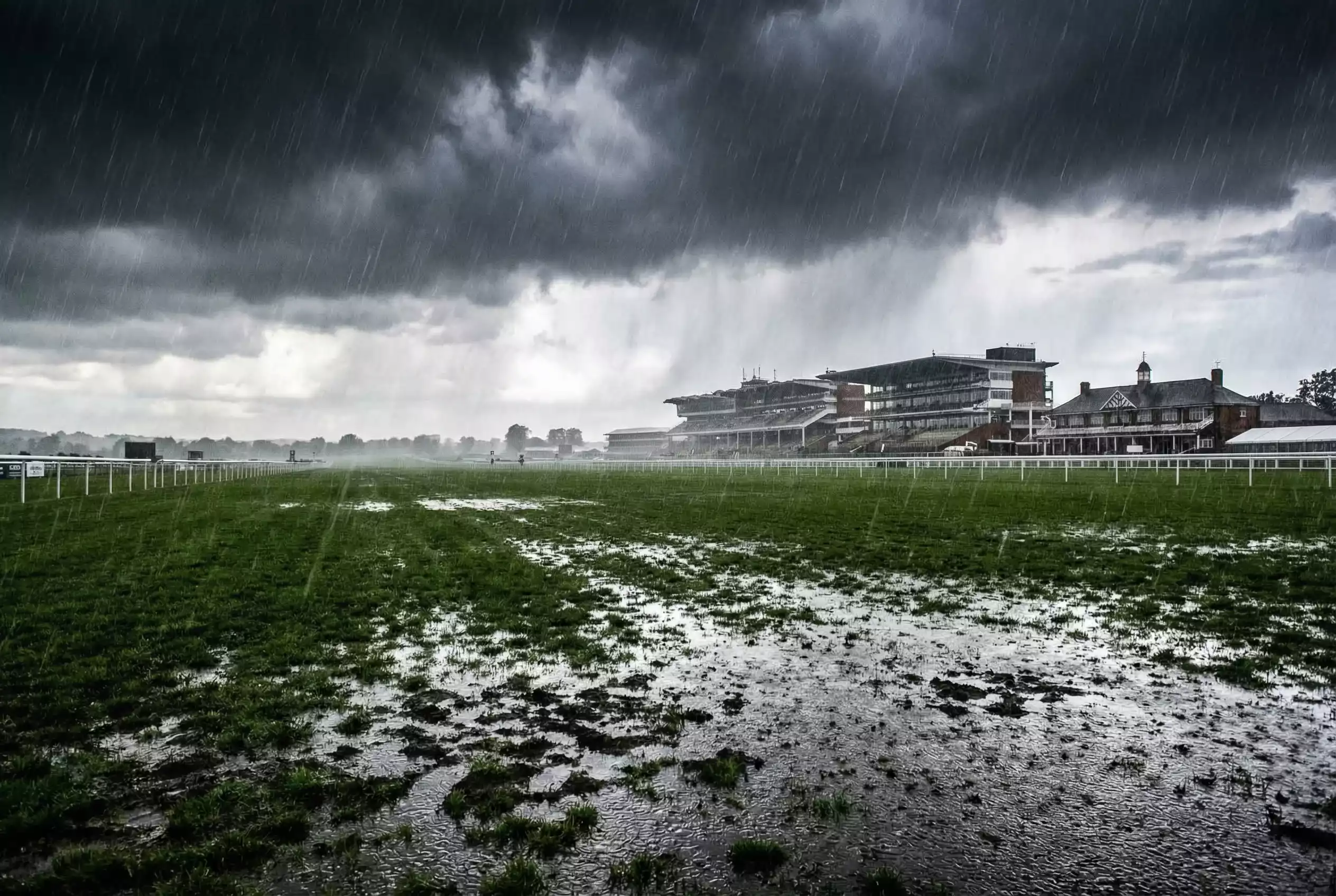
The going report tells you what the ground is. The weather forecast tells you what the ground will be. That distinction — between the current state and the future state — is the gap where non-runner predictions live. A punter who checks the going at 8am and bets accordingly is working with today’s data. A punter who checks the forecast first and anticipates how the going will change by race time is working 24 hours ahead. The weather is the upstream cause; the going is the immediate trigger; and the non runner is the downstream consequence.
Weather-driven non runners are the most predictable type. They follow rainfall patterns, temperature shifts, and wind exposure — all of which are forecastable with reasonable accuracy. Translating weather into NR probability is not meteorology. It is pattern recognition applied to a sport that plays out on grass, on soil, and in the open air.
The Chain — Weather Changes Going, Going Triggers Non Runners
The causal chain is short and direct. Rain falls. The ground absorbs it. The going shifts from good to good-to-soft, or from good-to-soft to soft. Trainers with horses unsuited to the new surface withdraw them. The racecard shrinks.
The chain operates with a lag. Heavy rain overnight may not be reflected in the morning going report if the course has good drainage. Equally, a morning downpour may not affect the afternoon card if the rain stops and the wind dries the surface. The lag between weather event and going change — and between going change and NR declaration — varies by course, by season, and by the intensity of the weather.
The shrinking pool of top-class horses adds vulnerability. BHA data shows the number of high-rated Jump horses (130+ rating) fell from 787 to 716 between 2023 and 2024, a 9% decline. Fewer quality horses in the system means each one is more valuable, and trainers are more protective — making weather-driven withdrawals more likely for the horses that matter most to the market.
Understanding the chain helps the punter anticipate rather than react. If rain is forecast for Friday evening and you are assessing a Saturday card declared under 48-hour rules, the going will likely be softer than the current description. The NR wave that follows is predictable in direction if not in precise magnitude.
Weather Forecasting Tools for Punters — Met Office, BBC and Racecourse Feeds
The Met Office is the primary forecasting source for UK racing weather. Its location-specific forecasts — available through the website and app — provide hourly rainfall probability, wind speed, and temperature for any racecourse postcode. The hourly breakdown is critical: knowing that rain is forecast at 60% probability between 6pm and midnight on Friday tells you more about Saturday’s going than a generic “rain expected” summary.
The BBC Weather app provides a similar service with a slightly different presentation. Its day-by-day summary is useful for longer-range planning (checking the forecast for Cheltenham week, for example), while the hourly view is useful for race-day precision. Both the Met Office and BBC use the same underlying meteorological data, so the differences between them are presentational rather than substantive.
Racecourse-specific feeds add a layer that generic forecasters cannot provide. Most UK racecourses post going updates through their official websites and social media accounts, often including commentary from the clerk of the course about how the ground is riding and whether further changes are expected. The clerk’s assessment combines the weather data with local knowledge — how the track drains, where the soft patches form, whether watering has been applied — and is the closest thing to ground truth available before you arrive at the course.
Specialist racing weather services, such as those provided by some premium data platforms, combine Met Office data with course-specific drainage models to produce going forecasts rather than just weather forecasts. These are niche tools aimed at serious punters, but they bridge the gap between raw weather data and the going assessment that drives NR decisions.
Wind and Its Underrated Impact on Jump Racing
Rain dominates the NR conversation, but wind is an underrated factor — particularly in Jump racing, where horses jump obstacles at speed and a strong crosswind can affect balance, jumping accuracy, and the willingness of trainers to run.
High winds create two specific risks. The first is safety: a horse jumping a fence in a strong crosswind is more vulnerable to being blown off its line on the landing side, increasing the risk of a fall. The second is performance: horses that race prominently — front-runners that set the pace — are more affected by headwinds than hold-up horses racing in the shelter of the pack. A strong headwind down the straight at a course like Wetherby or Kelso can fundamentally change the pace scenario, even if the going is unaffected.
Trainers do not routinely withdraw horses because of wind alone, but extreme conditions — Storm warnings, gusts above 50mph — can trigger cancellations of entire meetings or individual-race abandonments. Short of that threshold, wind acts as a marginal factor that may tip the withdrawal decision for a horse already on the borderline. A horse with a minor niggle that the trainer would accept on a calm day may become an NR when 40mph gusts are forecast.
For the punter, checking wind speed and direction for the racecourse — available through the Met Office hourly forecast — is a useful secondary input. It will not predict NRs on its own, but combined with the going forecast and the horse’s running style, it adds a dimension that most punters ignore entirely.
How Much Rain Triggers Going Changes — Approximate Thresholds
The relationship between rainfall and going changes is not linear — it depends on the course’s drainage, the soil type, the season, and how much rain has already fallen in the preceding days. But approximate thresholds exist, and knowing them turns a weather forecast into a going forecast.
On well-drained courses — Newbury, Ascot, Sandown — 10-15mm of rain over 24 hours will typically move the going by half a grade. Good becomes good-to-soft. Good-to-soft becomes soft. On poorly drained courses — Fontwell, Plumpton, some of the smaller National Hunt tracks — the same rainfall can move the going by a full grade or more.
The context of the season matters enormously. The first quarter of 2024 illustrates the point: 78% of Jump fixtures ran on soft or heavy ground, compared to a three-year average of 48%. That was not the result of a single storm. It was the cumulative effect of a wet autumn followed by a wet winter, where the ground never had a chance to dry out between meetings. In those conditions, even modest additional rainfall — 5mm — can push already-soft ground into heavy territory, because the soil is saturated and has no capacity to absorb more.
In summer, the equation reverses. The ground is naturally drier, drainage is faster, and 10mm of rain on a July evening may barely register on the going by the following afternoon. The same 10mm in January, falling on already-saturated ground, can trigger a wave of non runners across the card.
A Weather-Based Strategy for Predicting Non Runners
The strategy is simple in concept and requires only discipline in execution. Check the forecast first, before you check the racecard.
Step one: on the evening before race day, check the hourly rainfall forecast for the racecourse location. Note the total expected rainfall between now and the first race, and the timing of the heaviest period. If more than 10mm is forecast overnight, expect the going to change by at least half a grade.
Step two: identify which declared runners are vulnerable to that going change. Horses with a narrow going preference — those that have only won on good or firmer — are the highest NR risk. Horses trained by yards with high NR rates (available from BHA’s quarterly tables) are also more likely to withdraw if conditions shift.
Step three: on race morning, check the updated going report and the racecard for confirmed NRs. Compare the actual withdrawals to your predicted vulnerable runners. If your predicted NRs have materialised, the remaining field is the one you anticipated, and your pre-planned positions should hold. If unexpected withdrawals have occurred — horses you did not flag — reassess the race before committing.
Step four: before the off, check one final time. Late going changes — additional rain during the morning, or the clerk moving the rail to protect the ground — can trigger a second wave of NRs that the morning check did not capture. The forecast gave you the early warning. The final check confirms the reality. Between the two, you have a clearer picture than the punter who checked the forecast first — but only the racecard after.
Weather and Non Runners — More on this topic at non runners horses today.
See also Live Non Runner Tracking.
