

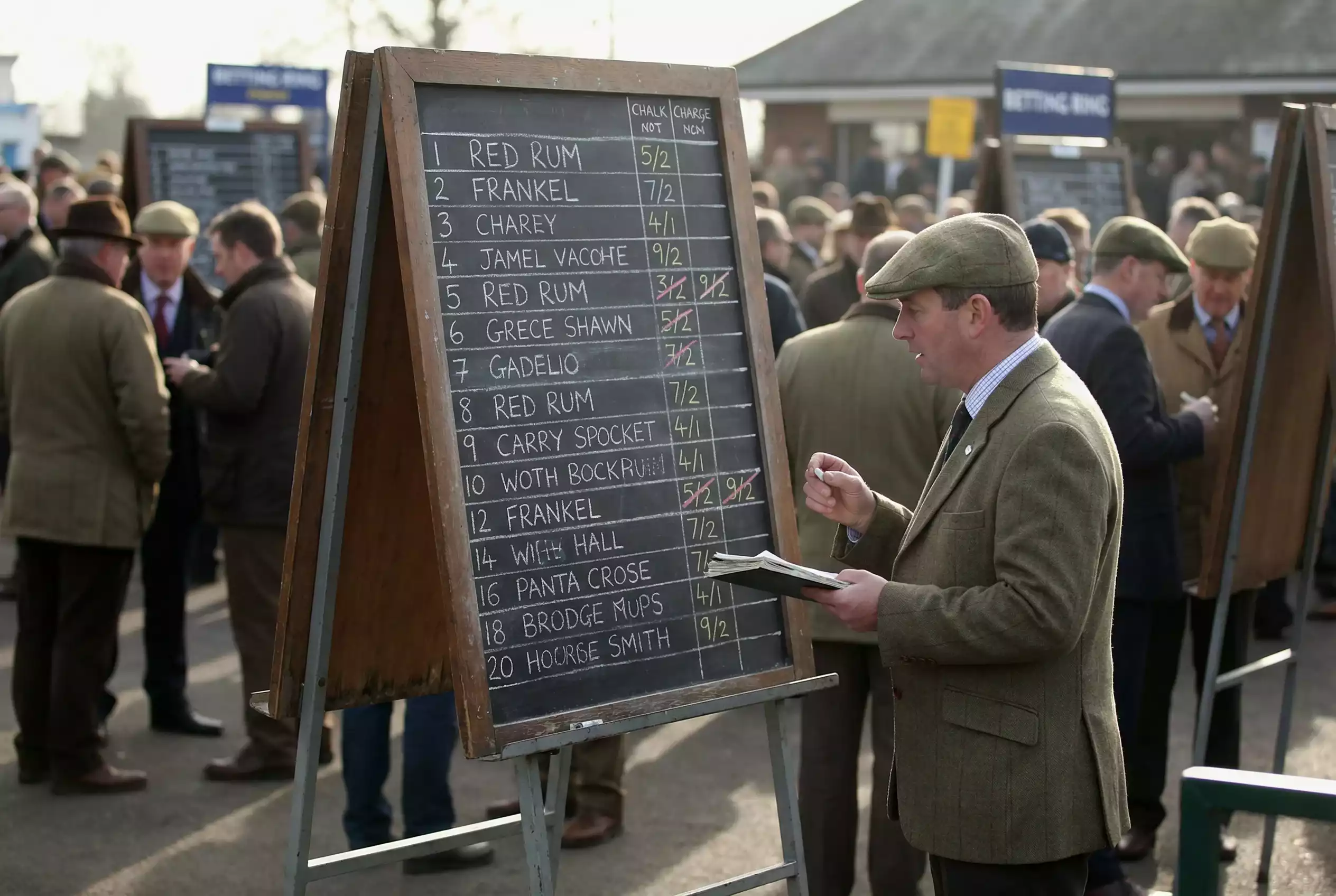
When a horse is declared a non runner, the market resets. Every remaining horse in the field is repriced, the overround shifts, and the starting price that will eventually be returned to SP bettors moves — sometimes significantly. That repricing window is one of the few moments in horse racing where the market is genuinely inefficient, because the adjustment happens fast but not instantaneously, and the punter who understands the mechanics can identify value before the prices settle.
This is not about Rule 4 deductions, which compensate for the NR after the fact. This is about the live market — the prices being offered by bookmakers and traded on the exchanges in the period between an NR being declared and the starting price being fixed. That window is where the opportunity sits.
How Starting Price Is Formed — On-Course Market and the SP Assessor
The starting price in British racing is determined by the on-course betting market. Before each race, on-course bookmakers display their odds on boards at the racecourse. The SP Assessor — an independent official — monitors these prices and records the prevailing odds at the moment the race starts. The SP is the price being offered by the majority of on-course bookmakers at the off, and it becomes the settlement price for any bet placed at SP.
The on-course market is influenced by several factors: the flow of money from punters at the track, signals from the off-course market (online bookmakers and exchanges), and the on-course bookmakers’ own assessment of each horse’s chance. It is a live, dynamic system — prices move constantly in the minutes before a race as money flows in on specific horses and bookmakers adjust to manage their liability.
The exchange market — primarily Betfair — runs alongside the on-course market and often leads it. A significant move on the exchange, where informed money tends to land first, filters through to the on-course boards within seconds. The SP, while technically determined on-course, is effectively a reflection of the entire market ecosystem at the moment of the off.
Understanding this process matters for the NR discussion because the SP is fixed at a single point in time. Everything that happens between the NR declaration and the off — every price adjustment, every flow of money, every bookmaker recalculation — is baked into the final SP. A non runner declared two hours before the race gives the market plenty of time to adjust. One declared ten minutes before the off creates a scramble, and the SP may not fully reflect the new reality.
What Happens to SP When a Horse Is Withdrawn — The Mechanics
When a horse is declared NR, its odds are removed from the market. The probability that was allocated to that horse — its share of the total market — is redistributed among the remaining runners. Every surviving horse shortens in price, though not by equal amounts. The redistribution follows the market’s existing structure: horses that are closely related in the market to the NR (similar profile, competing for the same position in the race) tend to shorten more than those in a different part of the field.
The mechanics are governed by the same Rule 4 deduction scale that determines the compensation paid to winning bettors. Under Tattersalls Rule 4(c), the deduction for a withdrawn horse at 3/1 is 25p in the pound. That same 25% implied probability is roughly what the market redistributes among the remaining runners. A 10/1 shot’s withdrawal triggers a 5p deduction and a correspondingly smaller redistribution.
In practice, the market does not redistribute probability uniformly. The favourite tends to absorb more of the withdrawn horse’s share than outsiders do, because the favourite is perceived as the most likely alternative for punters who were backing the NR. If the NR was a horse competing directly with the favourite — a second favourite or joint-favourite — the favourite may shorten dramatically. If the NR was an outsider with a different profile, the favourite’s price barely moves.
This asymmetric redistribution is where value can emerge. The market’s default assumption — that the favourite benefits most from an NR — is often correct, but not always. If the NR was a pace-setter that suited the favourite’s running style, the favourite may actually be weakened by the withdrawal even as its price shortens. The market is pricing the probability change but not always the tactical change.
Overround After a Non Runner — How Bookmaker Margin Adjusts
The overround — the sum of all implied probabilities in a market, always exceeding 100% — is the bookmaker’s built-in margin. In a typical 12-runner handicap, the overround might be 118%, meaning the bookmaker has an 18% theoretical edge before any bets are placed. When a horse is withdrawn, the overround drops because one set of odds has been removed.
The scale of the industry makes this margin significant. The Gambling Commission reported that gross gaming yield from online horse racing betting reached £766.7 million in the 2024-25 financial year. That revenue is built on overround margins applied across millions of bets, and any structural change in those margins — including the compression caused by non runners — flows through to the industry’s bottom line.
After an NR, bookmakers have two choices: reprice the remaining field to restore the original overround, or accept a temporarily lower margin. In practice, most do a combination of both. The initial repricing after an NR tends to produce a compressed market with a lower overround than before. Over the following minutes, bookmakers adjust individual prices to rebuild their margin, but they rarely restore it fully. The post-NR market is typically tighter than the pre-NR market.
For the SP bettor, this matters. A tighter overround means the SP is closer to the true probability — in other words, the bookmaker’s edge is smaller. The period immediately after a non runner declaration, when the overround is at its lowest, is theoretically the best time to place a bet at SP. The margin is compressed, and the prices on offer are fairer than they were before the withdrawal.
Tissue Prices vs Actual SP — Where the Gap Widens After NR
Tissue prices are the early-morning odds compiled by bookmakers before the on-course market opens. They represent the bookmaker’s initial assessment of each horse’s chances, based on form, going, draw, and trainer signals. The tissue is not a betting market — it is a forecast — and it often diverges from the actual SP once money flows in and the market adjusts.
A non runner widens the gap between the tissue and the SP. The tissue was compiled with the NR horse still in the field. Its removal changes the competitive picture, but the tissue is not updated — it is a static document, published once. The actual SP, formed live in the on-course market, reflects the NR. The difference between the two represents the market’s real-time assessment of how the withdrawal has changed the race.
The gap is most informative when the NR was a horse that significantly affected the market structure. A second-favourite withdrawal might shift the favourite from a tissue price of 3/1 to an SP of 5/2 — a meaningful compression. An outsider’s withdrawal might leave the tissue and SP virtually identical. Tracking these gaps over time — how much SPs move relative to tissues after NRs of different price ranges — gives the punter a sense of how efficiently the market reprices after withdrawals.
Punters who bet at SP rather than taking a fixed price can use this knowledge defensively. If a major NR occurs and the remaining favourite is likely to shorten, the SP on that horse may represent worse value than the fixed price offered an hour earlier. Conversely, if the NR was a pace-setter and the tactical change is likely to harm the favourite, the SP on mid-priced alternatives may offer better value than their tissue prices suggested.
Spotting SP Value After a Non Runner — Practical Approach
The practical framework is straightforward. When a non runner is declared, ask three questions.
First: what was the NR’s implied probability? A short-priced withdrawal creates a larger redistribution and more price movement. The bigger the price change, the more scope for the market to misprice something. A 50/1 outsider being withdrawn barely moves the needle — do not waste time analysing it.
Second: who benefits tactically? The market reprices based on probability, but it often underweights tactical changes. If the NR was the only pace-setter, horses with tactical speed gain an edge that the market may not fully price in. If the NR was a draw rival on the advantaged side of the track, horses on that side become more valuable. These are the angles where SP value tends to hide.
Third: has the overround compressed? Check the prices on all remaining runners. If the total implied probability has dropped noticeably — from 118% to 112%, for example — the market is offering fairer prices across the board. In a compressed market, even the favourite may represent value relative to its true probability.
The window is short. Markets reprice within minutes of an NR, and the opportunity is most acute in the first 10 to 15 minutes after the declaration. For on-course punters, the repricing is visible in real time on the bookmaker boards. For online bettors, the exchange market adjusts fastest, followed by the major online bookmakers. Speed of assessment, not speed of execution, is the edge — knowing what to look for before the NR is declared, so that when it happens, you can evaluate and act while the market is still settling.
How Non Runners Affect Starting Price — More on this topic at non runners horses today.
See also When Are Non Runners Announced.
