

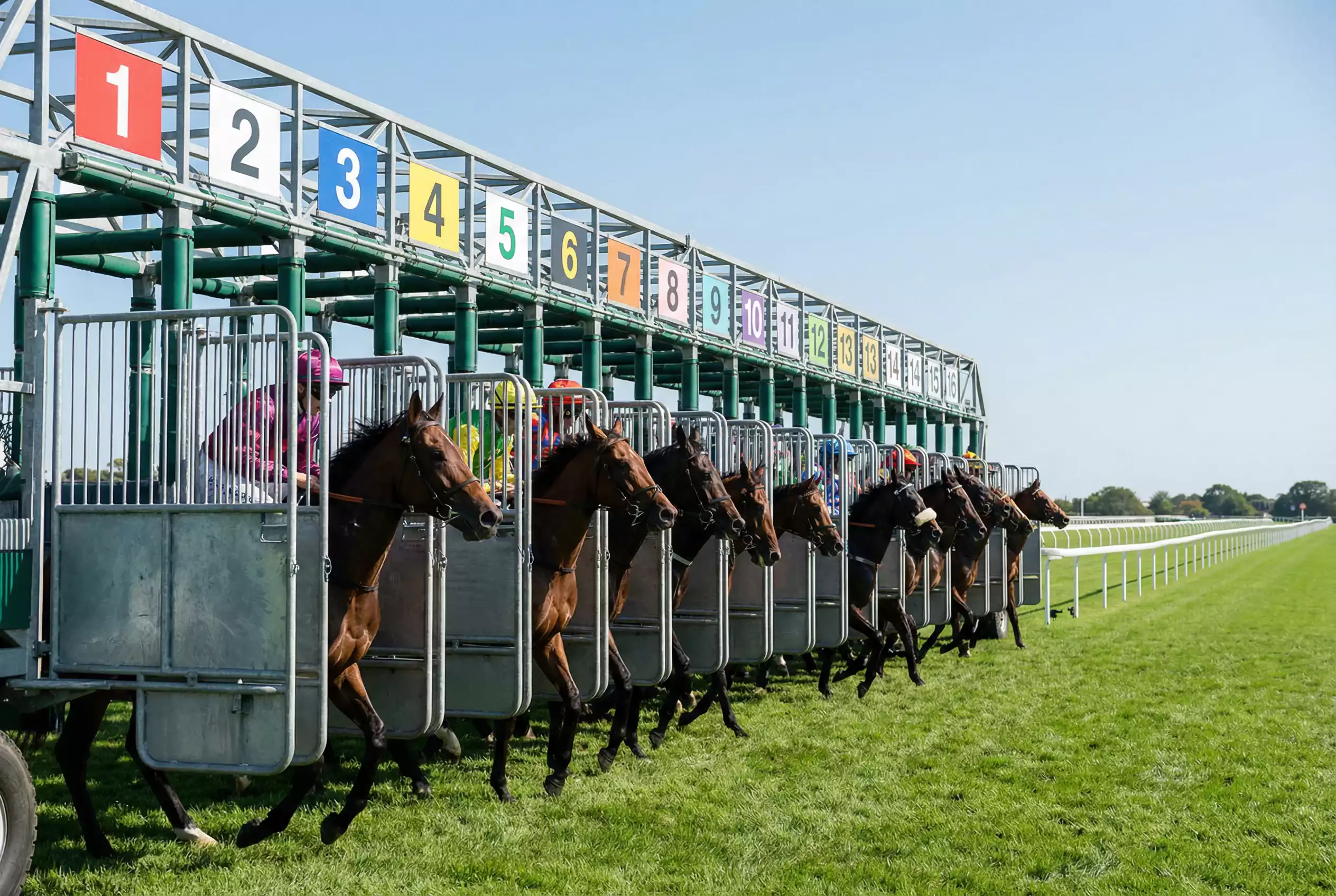
The draw just changed. A horse has been declared a non runner, and everything you studied about stall positions last night needs revisiting. In Flat racing, the draw is one of the most powerful predictors of outcome — at certain courses and over certain distances, stall position can matter more than form. When a non runner removes a horse from the stall line-up, the advantage can shift from one side of the track to the other. Most punters check the going after an NR. Far fewer check the draw. That oversight is where value hides.
This is a topic that sits at the analytical edge of race assessment. Few sources cover it in depth, and fewer still quantify the effect. The mechanics are not complicated, but applying them consistently requires understanding how stalls are renumbered, how rail movements interact with withdrawals, and how to recalibrate your draw analysis once the racecard thins out.
How the Draw Works in Flat Racing — A 60-Second Primer
In every Flat race run from starting stalls, each horse is assigned a stall number by random draw. Stall 1 is closest to the inside rail. The highest-numbered stall is on the outside. Between those two positions, a horse’s proximity to the rail — and the advantage or disadvantage that proximity confers — depends on the course, the distance, and the going.
On straight courses — Ascot’s straight mile, the July Course at Newmarket, the five-furlong sprint at York — the draw operates across the full width of the track. If the ground is faster on one side, horses drawn on that side have a measurable edge. On round courses, the draw matters most in sprints and short-distance races where the first bend arrives quickly. A horse drawn wide has further to travel to the rail, and in a fast-run sprint, that extra ground can be the difference between winning and finishing mid-division.
The draw is not static. It shifts with conditions. As Shaun Parker, BHA Head of Stewarding, noted when announcing rule changes in 2025: “Ultimately, this is about fairness, both for the participants and the betting public.” Rail movements, going changes, and — critically — non runners all alter the draw dynamic after the stall numbers have been assigned. The number on the racecard is the starting point, not the final word.
What Happens to Stall Numbers When a Horse Is Withdrawn
When a horse is declared a non runner after the draw has taken place, its stall is left empty. The remaining horses do not physically move to fill the gap — they stay in their assigned stalls. But the effective draw changes because the spatial relationship between the runners has shifted.
Consider a 16-runner sprint where the horse in stall 5 is withdrawn. Stalls 1 through 4 remain as they were. Stalls 6 through 16 also stay in their original positions. But stall 6 is now effectively one position closer to the nearest group of runners on the inside. The gap where stall 5 used to be creates a pocket of space that the horse in stall 4 or stall 6 can exploit, depending on the pace and the jockey’s tactics.
In large fields, these shifts are more meaningful. BHA data shows that average field sizes at Flat Premier racedays reached 10.86 in 2024, up from 10.50 the previous year. In a field of 11, the withdrawal of a horse from the middle stalls creates a measurable gap in the line that can benefit horses drawn on either side of the empty position. In smaller fields, the same withdrawal has a proportionally larger effect — removing one of seven runners changes the geometry of the race more dramatically than removing one of twenty.
The key principle is that the draw is relational, not absolute. Stall 3 is only a good draw because of its position relative to the other runners and the rail. Remove a horse between stall 3 and the rail, and stall 3’s advantage diminishes. Remove a horse on the outside of stall 3, and its position may improve. Every NR redraws the map.
Low Draw vs High Draw — How NR Tilts the Balance
The traditional draw bias at most UK Flat courses favours low draws — positions closer to the inside rail — particularly on straight courses and in sprints on turning tracks. Horses drawn low save ground, take the shortest route, and can establish position early without expending energy to cross from the outside.
A non runner from the low stalls disrupts this pattern. If stall 2 is vacated, stall 1 is now isolated on the inside with a gap to its right. The horses in stalls 3 and 4, which were hemmed in, now have more room to manoeuvre. The tight cluster that often forms on the inside rail loosens, and the pace dynamic changes — front-runners from low draws may find less pressure on the inside, or conversely, more room for stalkers to settle behind them.
A non runner from the high stalls has the opposite effect. The outside group shrinks, and the horses that remain on the wide side have fewer bodies to navigate around. On a course where the going is better on the far side — a scenario that arises when rail movements push the fresh ground away from the stands rail — the withdrawal of a high-drawn runner removes competition for the faster strip.
The BHA’s fixture planning adds context. In 2024, around 200 Flat races were moved from summer to autumn to improve field quality and competitiveness. Autumn Flat racing often features softer ground, which amplifies draw biases as wet patches form unevenly across the track. Non runners in autumn handicaps, where the draw is already more influential than in summer, carry a proportionally larger impact on the stall advantage.
Rail Movements and Non Runners — A Double Shift
Rail movements are an underappreciated variable that interacts directly with non-runner effects. At many UK courses, the clerk of the course moves the inside running rail during the meeting — typically to protect the ground on the inside for later races. The rail may be placed two, four, or even six metres out from its standard position.
When the rail is moved out, the effective width of the track changes. The stands side becomes the new inside, and horses drawn high — normally on the outside — are now closer to the fastest ground. This inversion of the standard draw bias catches punters who rely on historical draw data without accounting for the rail position on the day.
Now add a non runner. A high-drawn horse is withdrawn on a day when the rail has been moved out. That horse was in the group that would have benefited from the rail movement. Its removal means less competition for the advantaged side of the track, and the remaining high-drawn runners may shorten in price as the market adjusts. Conversely, if a low-drawn horse is withdrawn on a rail-movement day, the stands side loses a runner, and the inside group — which was already disadvantaged by the rail position — becomes even less competitive.
The double shift — rail movement plus non runner — creates scenarios that are invisible to punters who check only the draw or only the NR list, but not both. Combining the two gives a more complete picture of where the advantage lies, and it is a step that separates systematic punters from casual ones.
Adjusting Your Draw Analysis After a Non Runner
The process for updating draw analysis after a non runner is not complicated, but it requires discipline. Here is a practical approach.
First, identify which stall the withdrawn horse occupied. This is published on the racecard alongside the NR designation. Note its position relative to the rail and relative to the other runners.
Second, check the rail position. If the rail has been moved, the standard draw bias may be inverted. Most racecourses publish rail movements in the morning going report or through social media updates from the clerk of the course.
Third, reassess the runners on either side of the empty stall. The horses immediately adjacent to the NR now have more room. If one of them is a prominent racer that needs space to stride out, the withdrawal may benefit it disproportionately. If it is a hold-up horse that prefers to be covered up in a cluster, the extra space may actually be a disadvantage.
Fourth, look at the pace map. The draw affects pace in sprint races especially. If the NR was a known front-runner from a low stall, the pace scenario changes. The remaining low-drawn runners may have less early pressure, allowing them to establish position more easily — or, without a pace-setter to follow, hold-up horses from those stalls may struggle to find the tempo they need.
This is not a five-minute exercise. But for anyone betting seriously on Flat handicaps — particularly at Ascot, York, Chester, and Newmarket, where the draw is a proven factor — it is the difference between an informed bet and a guess. The draw just changed, and your analysis should change with it.
How Non Runners Affect the Draw — More on this topic at non runners horses today.
See also Pace Impact of Non Runners.
