

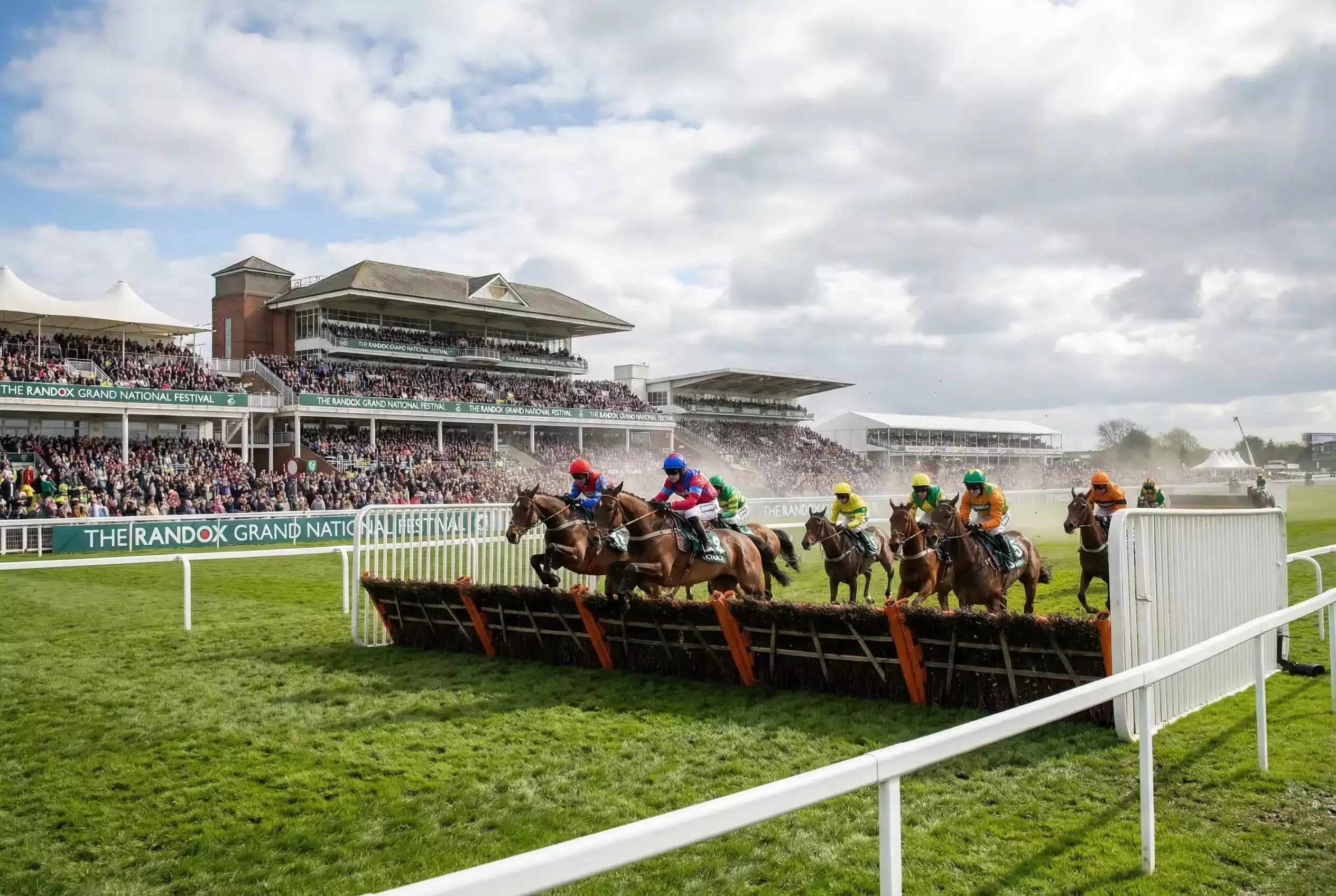
The Aintree Festival is three days of Jump racing that build towards the Grand National on Saturday — and across the three days, the non-runner picture changes shape. Thursday’s card opens the meeting with championship-calibre races on the Mildmay Course. Friday brings the Topham Chase over the Grand National fences. Saturday is the main event, with the National itself capping the programme.
Each day carries a different NR profile. Thursday’s fields are typically the most stable, with trainers committed to running their best horses in Grade 1 company. By Friday, the going report has had two days to evolve, and trainers with multiple entries across the meeting start making choices about which races to prioritise. Saturday adds the unique dynamics of the Grand National: the 72-hour declaration window, the reserve system, and the sheer scale of a 40-runner field over the most demanding fences in the sport.
For the punter betting across the three days, understanding where non runners cluster — and why — turns a festival-long strategy from reactive to informed.
Non Runner Overview Across Three Aintree Days
Aintree’s non-runner profile across the three days follows a pattern that repeats, with variations, from year to year. The pattern is driven by two forces: the weather and the structure of the programme.
Thursday — the opening day — tends to have the lowest NR count. The declarations for Thursday races are made under the standard 48-hour window (Sunday/Monday), and trainers who have targeted their best horses at the Aintree Grade 1s are unlikely to withdraw unless there is a genuine issue. The Aintree Hurdle, the Bowl Chase, and other Thursday features attract committed runners from the top yards in Britain and Ireland, and the going at this point in the meeting is typically fresh — the ground has not yet been raced on, and any watering or rainfall has had time to settle.
Friday sees a slight uptick. By now the going has been tested by Thursday’s racing. If the ground has ridden softer or firmer than the official description suggested, trainers with Friday entries have a real-time data point that was not available at declaration time. The Topham Chase — run over the Grand National fences — is a race where the going matters acutely, and it is one of the Friday cards most likely to lose a runner or two if conditions have shifted.
Saturday is a different beast entirely. The Grand National’s separate declaration process and reserve system create their own NR dynamics, which are covered in depth elsewhere. The supporting races on Saturday also carry higher NR risk simply because they fall at the end of a long week — trainers who have run horses on Thursday or Friday may reassess their Saturday entries based on how those earlier runs went.
Year-on-Year Trends — Are Aintree Non Runners Rising or Falling?
Aintree’s NR trends track closely with the broader direction of Jump racing in the UK, where the horse population has been under pressure. According to BHA data, the total number of horses that ran at least once in 2024 fell by 178 to 18,452 — a 1% decline driven primarily by a 3% drop on the Jump side. Fewer horses in training means smaller pools of potential runners for festival meetings, and Aintree is not immune to that contraction.
The effect at Aintree is visible in the supporting races more than the features. The Grade 1 contests still attract strong fields — the prize money and prestige ensure that — but the handicaps and listed races beneath them have felt the squeeze. A handicap hurdle that might have attracted 14 runners five years ago may now field 10 or 11, and the loss of even one or two to NR on the morning of the race can turn a competitive handicap into a sparse affair.
Weather-driven variation complicates the year-on-year comparison. A dry April — uncommon but not unheard of — produces an Aintree Festival with minimal non runners and full fields. A wet one, particularly if the rain arrives after declarations, pushes the NR count up sharply. The 2024 Jump season, marked by prolonged wet weather that saw 78% of early-year fixtures on soft or heavy going, illustrated how seasonal conditions can overwhelm structural trends.
The direction of the underlying trend — fewer Jump horses, stable or slightly falling field sizes at premier meetings — suggests that Aintree non runners will remain a persistent feature of the festival rather than a diminishing one. The practical response for punters is to treat each year’s Aintree card as provisional until declarations are confirmed, and to monitor the going and trainer news right up to the morning of each day.
Topham and National Day — Where Non Runners Cluster
Two races at the Aintree Festival are most susceptible to non-runner clustering: the Topham Chase on Friday and the Grand National on Saturday. Both are run over the National fences, and both attract fields where the going and the course demands produce a higher-than-average NR rate.
The Topham Chase is a handicap over two miles and five furlongs of the Grand National course. It is one of the most popular betting races of the festival — a competitive handicap with large fields and unpredictable results. But the National fences are demanding, and trainers are protective of horses that may not handle the unique obstacles. If the going turns soft, the attrition rate at the fences increases, and trainers who might run their horse on a conventional chase course will withdraw from the Topham rather than risk injury over the bigger jumps.
The Grand National itself operates under the 72-hour declaration window introduced for 2026, with six reserve runners standing by. The extended window means the National’s NR picture is settled earlier in the week than the supporting races, but late withdrawals — typically on going grounds or overnight veterinary concerns — can still occur inside the 72-hour window, triggering the reserve system. The scale of the field (40 runners) means that even a small NR percentage translates into multiple withdrawals in absolute terms. Two or three non runners from a 40-horse field is five to eight per cent — a rate that would be unremarkable in ordinary racing but carries enormous market implications when the withdrawn horse was a leading ante-post contender.
For punters, the Topham and National are the races to monitor most closely for NR risk. Both are going-sensitive, both attract large fields, and both are among the most heavily bet races of the meeting. Checking the going report after Thursday’s racing — before the Topham and National declarations are finalised — gives you the best read on which runners are vulnerable.
Going at Aintree — How the Mildmay and National Courses Differ
Aintree operates two distinct courses, and the going can ride differently on each. The Mildmay Course hosts the Thursday and Friday feature races — hurdles and conventional chases on a sharp, left-handed track. The National Course, used for the Topham and the Grand National, runs over the famous spruce fences on a wider, flatter layout. The drainage, the soil composition, and the amount of racing each course absorbs during the week all affect how the going holds up.
The Mildmay Course tends to be the more predictable surface. It drains reasonably well, and the going description issued on Monday or Tuesday for Thursday’s racing usually holds. When it does shift, the change is typically modest — good to good-to-soft, or good-to-soft to soft — and the impact on non runners is proportionate. Trainers expect the Mildmay to ride close to the described going, and they declare accordingly.
The National Course is less forgiving. The longer circuit takes more punishment from sustained rain, and the ground around the Canal Turn and the fences beyond it can become significantly softer than the going description suggests. Trainers who walk the course on Friday morning — standard practice before the Topham and the National — sometimes report conditions that differ from the official going by half a grade or more. That gap between the official report and the on-the-ground reality is where last-minute NR decisions are made.
Aintree’s clerk of the course provides regular updates through the week, and the racecourse’s social media channels are a useful real-time source. But the most reliable going intelligence comes from trainers and jockeys who have walked or ridden the course that morning. Following their commentary in racing media on Thursday evening and Friday morning gives the punter a ground-level view that the official going report may not fully capture.
NRNB at Aintree — Which Races and Which Bookmakers
NRNB offers at Aintree are concentrated on the Grand National, but several bookmakers extend protection to other races across the three days. The coverage varies, and the distinction between what is covered and what is not can be the difference between a refunded stake and a lost one.
For the Grand National itself, NRNB is universally available from major UK bookmakers. The terms mirror those offered for Cheltenham: ante-post bets on runners who are subsequently declared NR receive a stake refund, typically as cash or a free bet. The qualifying window usually opens when ante-post markets are first published — months before the race — and closes at or before the 72-hour declaration deadline. Bets placed after that point are treated as day-of-race bets and are covered by standard NR refund rules.
Beyond the National, NRNB coverage is patchier. Some operators offer festival-wide NRNB for selected Aintree races — the Aintree Hurdle, the Melling Chase, the Topham — while others limit the promotion to the National alone. The ante-post market for the supporting races is smaller and less liquid than the National, which means bookmakers have less commercial incentive to offer blanket NRNB across the full three days.
For punters building a festival-long portfolio of ante-post bets, the NRNB map across Aintree requires careful checking. It is not safe to assume that a bookmaker offering NRNB on the Grand National also offers it on the Topham or the Aintree Hurdle. Each race may have different qualifying terms, different maximum stakes, and different refund mechanisms. Reading the specific promotion terms for each race — not just the headline NRNB banner — is the only way to confirm that your positions are protected across the three days.
Aintree Festival Non Runners — More on this topic at non runners horses today.
See also Horse Bolts or Refuses Stalls.
