

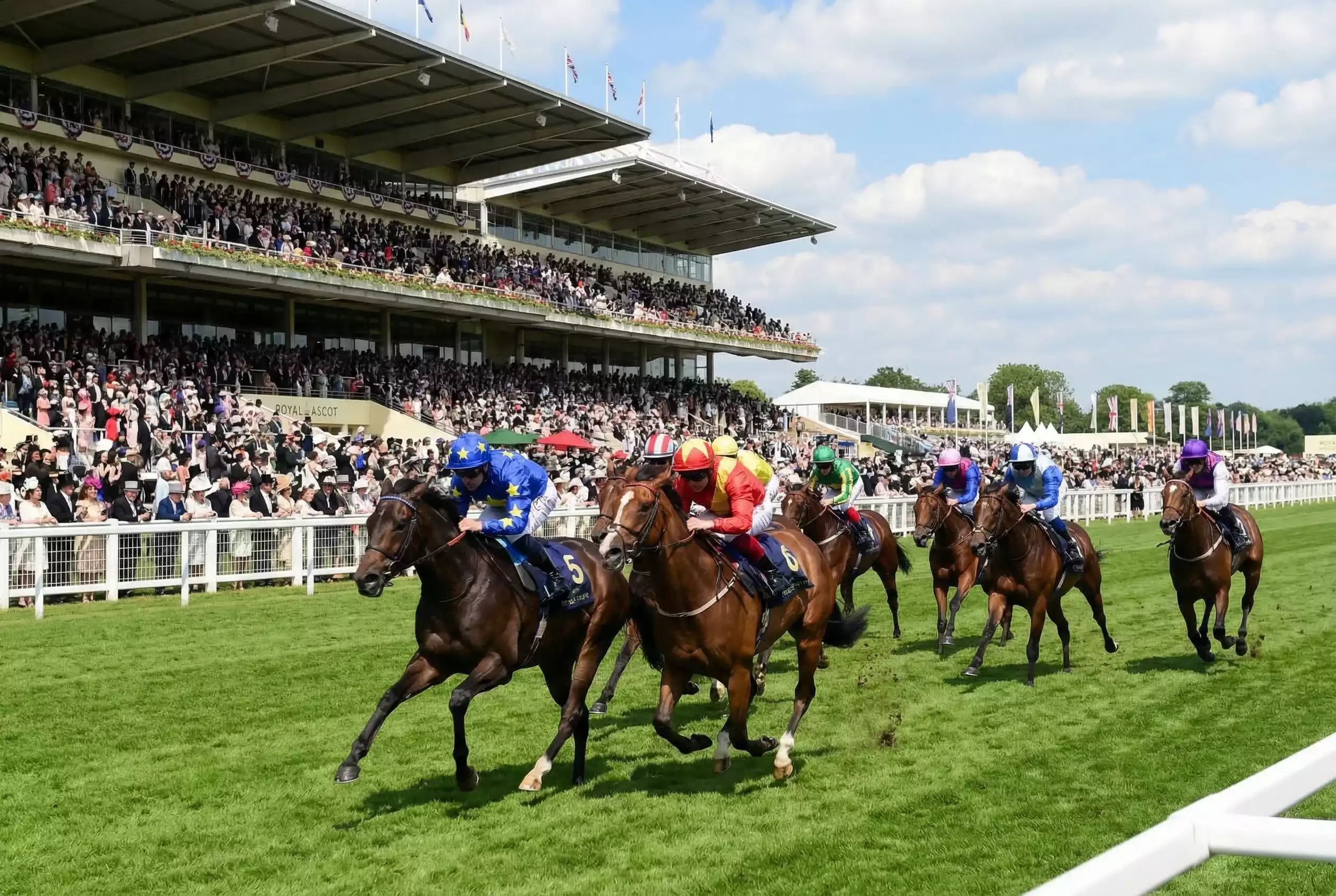
Royal Ascot is the flagship of the Flat calendar, five days of championship racing in June where every non runner shifts the balance of power. Unlike Cheltenham, where the going is often the dominant variable, Ascot’s NR dynamics are shaped by a combination of ground conditions, international travel logistics, and — critically — the draw. On the straight mile, where some of the meeting’s biggest races are run, a single withdrawal can flip the draw advantage from one side of the track to the other.
The meeting attracts runners from around the world. Horses travel from Ireland, France, the United States, Japan, and Australia, many of them ground-sensitive and unaccustomed to British conditions. That international contingent raises the base level of NR risk at Royal Ascot beyond what a purely domestic fixture would produce. When the weather shifts or the going moves away from the description that persuaded connections to make the trip, the withdrawal is swift.
For the punter, Royal Ascot demands a different NR analysis than any other meeting — one that weighs the draw, the going, and the composition of the field simultaneously.
Non Runner Patterns at Royal Ascot — Numbers and Trends
Royal Ascot’s non-runner numbers are influenced by the same factors as any major meeting — going changes, veterinary issues, strategic withdrawals — but the scale of the entries amplifies the effect. Fields at the Royal Meeting tend to be larger than at any other Flat fixture, with some handicaps attracting 20 or more declared runners. Large fields mean more horses at the margins, and more horses at the margins means more potential withdrawals.
The trend in Flat Premier field sizes has been positive in recent years. BHA data shows average field sizes at Flat Premier racedays rose from 10.50 in 2023 to 10.86 in 2024 — a modest but meaningful increase that reflects efforts to concentrate quality racing on fewer, bigger cards. Royal Ascot sits at the apex of this strategy, consistently attracting the largest and most competitive fields on the Flat calendar.
Larger fields carry a structural NR consequence. In a 20-runner handicap, the probability that at least one horse will be withdrawn is significantly higher than in an 8-runner Group race. The handicaps — the Royal Hunt Cup, the Wokingham, the Britannia — are the races most likely to lose runners on the morning of the card. The championship races — the Queen Anne, the Prince of Wales’s, the Gold Cup — tend to hold their fields better, because the horses targeted at those contests have been specifically prepared and their ground preferences are well known to trainers.
Year-on-year, Royal Ascot’s NR count fluctuates with the weather. A dry week in June keeps withdrawals low and fields intact. A wet week pushes the going towards soft, and the NR list grows as trainers pull horses that need faster ground. The pattern is consistent enough to track: check the long-range forecast for Ascot week, and you have a reasonable early indicator of whether the racecard will thin out.
What Makes Royal Ascot Unique — International Raiders and Ground Sensitivity
What separates Royal Ascot from other Flat meetings is the depth of its international contingent. Horses ship in from multiple countries, often arriving in the UK only days before they are due to race. That travel introduces variables — acclimatisation, the unfamiliarity of British going descriptions, the physical stress of the journey — that increase the probability of withdrawal.
A French-trained horse that has only ever raced on Longchamp’s well-drained surface may be entered for the Queen Anne Stakes with a going preference of good. If the Ascot going report shifts to good-to-soft after overnight rain, the trainer faces a decision: run on ground the horse has never experienced, or withdraw and wait for a more suitable opportunity at home. The international raider is, by definition, less flexible than a domestic runner who can be redirected to a meeting next week.
As Richard Wayman noted when discussing BHA’s strategy for its premier fixtures: the goal was to make the best racing better and use that as the tool to grow interest in the sport. Prize money on Premier racedays in 2024 was over £7 million higher than the previous year. Royal Ascot is the embodiment of that strategy — a meeting designed to attract the best horses from the widest possible pool. But the wider the pool, the more sensitive the entries become to conditions on the ground.
The Japanese raiders that have become an increasingly common feature of the meeting in recent years illustrate the point. A horse that has travelled 6,000 miles is not going to be withdrawn lightly, but a genuine concern about the going — or a minor issue that developed in transit — can tip the decision. The stakes are too high, and the journey too long, to risk the horse on unsuitable ground. That calculus produces non runners that the market may not have fully priced in.
Going at Ascot — How the Straight Course Drains Differently
Ascot’s course layout creates going dynamics that are specific to the venue. The straight course — used for races up to a mile — runs slightly downhill and drains differently from the round course. In dry conditions, the straight tends to ride faster than the round course, favouring speed horses and front-runners. When rain arrives, the straight can become testing more quickly in some sections, particularly where the camber pushes water towards the stands side.
The going description at Ascot is usually uniform — good, or good-to-soft — but experienced punters know that the ground does not ride identically across the width of the track. The stands rail, the far rail, and the centre can all offer slightly different surfaces, and the clerk of the course may move the running rail during the week to protect ground for the later days of the meeting.
For context, the going’s impact on non runners is most visible in Jump racing — in the first three months of 2024, 78% of Jump fixtures ran on soft or heavy ground, compared to a three-year average of 48%, according to BHA data. Flat racing in June rarely approaches those extremes, but even a shift from good to good-to-soft at Ascot is enough to trigger withdrawals from horses that are marginal on that surface. The Flat equivalent of the soft-ground NR spike is more subtle than the Jump version, but it is real, and it is concentrated in exactly the high-stakes races that attract the most betting interest.
Ascot publishes going updates daily during Royal Meeting week, with the clerk of the course providing additional commentary after watering or rainfall. Monitoring these updates is essential for any punter holding positions in races on the straight course, where the going can shift between the morning report and the afternoon card.
Draw Bias After Non Runners — Low vs High on the Straight Course
The draw at Royal Ascot is one of the most analysed variables in Flat racing, and non runners change the equation in ways that are easy to underestimate. On the straight course, where races from five furlongs to a mile are run, stall position matters — and it matters differently depending on the going, the field size, and the position of the running rail.
In large-field handicaps on good ground with the rail in its standard position, a low draw — closer to the stands side — has historically been an advantage at Ascot. Horses drawn low can save ground along the rail and avoid the kickback from runners ahead. But when a non runner is withdrawn from the inside stalls, the remaining horses in those positions shift up. What was stall 2 effectively becomes stall 1 in terms of proximity to the rail, and the advantage recalibrates.
The effect is more pronounced in soft ground. When rain arrives and the ground is slower on one side of the course, the clerk may move the running rail to protect the faster ground for later races. That rail movement can invert the draw bias entirely — suddenly a high draw is closer to the fresh ground, and a low draw is on the churned-up surface. A non runner from the high stalls in this scenario removes a horse from the advantaged side, potentially creating value among the remaining high-drawn runners whose odds have not adjusted to the new reality.
The practical application is to reassess draw analysis after every non runner is declared. The draw data you studied before declarations was based on a full field. Each withdrawal changes the geometry of the race, and in a 20-runner handicap on the straight mile, two or three non runners can meaningfully alter which side of the track holds the edge.
This is not theoretical. Punters who specialise in Royal Ascot handicaps routinely wait until after the final declarations — and after the going report on the morning of the race — before finalising their draw-based selections. The non-runner list is as important as the stall draw itself.
How Non Runners Change the Competitive Picture at Royal Ascot
Beyond the draw, non runners at Royal Ascot reshape the competitive picture in ways that are specific to the meeting’s profile. The Royal Meeting features a mix of championship-level Group races and ultra-competitive handicaps. Non runners affect each type differently.
In Group races — the Queen Anne Stakes, the St James’s Palace, the Gold Cup — the fields are small and the form is well known. A single NR in an eight-runner Group 1 can fundamentally change the market. If the withdrawn horse was the likely pace-setter, the race shape alters. If it was the clear second favourite, the remaining horses compress in price and the favourite may shorten to odds that no longer represent value. These races are where individual non runners have the largest proportional impact on the betting.
In handicaps, the effect is diluted by the larger field but concentrated by the draw. A non runner in the Wokingham — typically a 20-plus runner sprint — barely moves the prices of the remaining runners. But if the withdrawn horse was drawn in a key position, its absence changes the running dynamics for the horses around it. The punter who only checks the prices after an NR misses the real story, which is about position and pace, not just probability.
Royal Ascot also sits at the intersection of ante-post and day-of-race markets. Many punters take ante-post positions weeks before the meeting, particularly on the championship races. A non runner on the morning of the race triggers standard NR refund rules on day-of-race bets but leaves ante-post bets exposed unless NRNB protection was in place. The meeting’s prestige and the emotional attachment punters feel towards their Ascot selections makes the ante-post NR sting especially sharp — a fact that bookmakers know and address through targeted NRNB promotions.
Royal Ascot Non Runners — More on this topic at non runners horses today.
See also Aintree Festival Non Runners.
